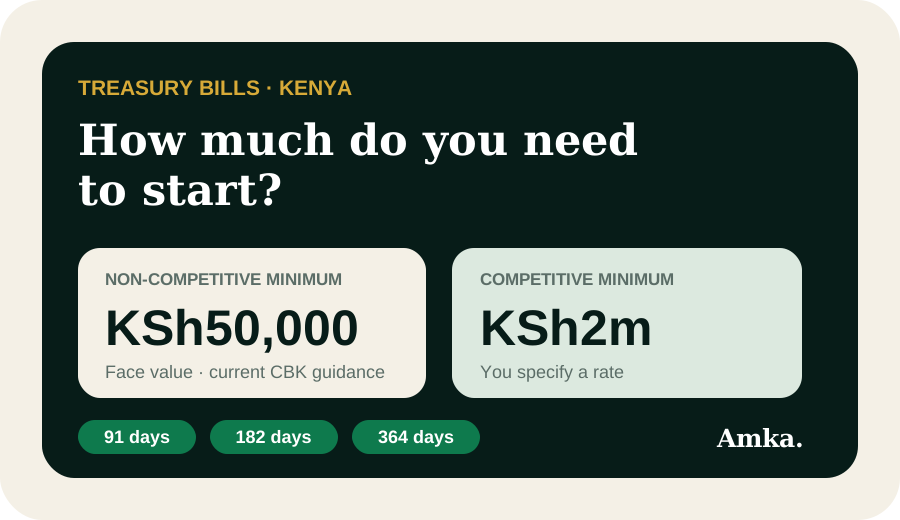
How much do you actually need to buy a Treasury Bill in Kenya? The Central Bank of Kenya’s current Treasury Bills guidance states that the minimum face value is KSh50,000 for a non-competitive bid. Competitive bids start at KSh2 million, and bids are made in KSh50,000 denominations.
That makes KSh50,000 one of the most useful numbers for a first-time T-Bill reader to understand. But it is only the starting point. The amount you bid is the face value, Treasury Bills are sold at a discount, and the cash payment after an auction depends on the accepted rate and CBK’s payment advice.
What does the KSh50,000 minimum mean?
CBK describes KSh50,000 as the minimum face value purchase for non-competitive Treasury Bill and bond bids. Face value is the amount the security is designed to pay at maturity. Because a Treasury Bill is sold at a discount, the purchase amount is normally below its face value.
So “minimum investment KSh50,000” should not be read as a promise that exactly KSh50,000 leaves your account on settlement day. After the auction, CBK provides the amount payable for successful bids. This distinction matters when planning cash: the bid face value, settlement amount and maturity amount are related, but they are not the same label.
Why do some pages still mention KSh100,000?
There is an important source-quality wrinkle. An older CBK Financial Markets explainer still contains a KSh100,000 minimum, while CBK’s dedicated current Treasury Bills and Securities pages state KSh50,000. For current access requirements, Amka is using the dedicated product guidance and advises checking the latest auction instructions before submitting a bid.
This is exactly why dates and source context matter in financial content: an official page can remain online after a newer operational rule has been published elsewhere on the same institution’s website.
Non-competitive vs competitive T-Bill bids
For many individual investors starting near the minimum, the relevant category is the non-competitive bid. You do not choose the interest rate. Instead, a successful non-competitive bid receives the weighted average rate determined by the auction.
A competitive bid is different: the bidder specifies the rate they want, and CBK can accept or reject the bid depending on the auction outcome. CBK currently sets the competitive minimum at KSh2 million. Naming a rate is not a guarantee that the bid will be allocated.
What rates are in the market on 17 September 2026?
CBK’s offer page for the 17 September 2026 auction shows previous average rates of 8.7674% for the 91-day Bill, 8.9296% for 182 days and 9.0665% for 364 days. The value date is 21 September 2026.
| Maturity | Previous average rate | Approximate commitment |
|---|---|---|
| 91-day | 8.7674% | About 3 months |
| 182-day | 8.9296% | About 6 months |
| 364-day | 9.0665% | About 12 months |
Those are previous auction averages, not guaranteed rates for today’s auction. Accepted rates can change each week. Amka therefore separates dated market data from the evergreen explanation of how a T-Bill works.
How do you buy a Treasury Bill through DhowCSD?
CBK says individuals and companies can access government securities directly through the DhowCSD portal or mobile app after opening a CSD account. The broad process is:
Use CBK’s DhowCSD platform and complete the required account-opening process.
Select the 91, 182 or 364-day Bill based on the period for which you can commit the money.
Select competitive or non-competitive, enter the face value in the required denomination and submit before the auction closes.
If successful, use CBK’s payment instructions and meet the settlement deadline.
What should you compare before committing KSh50,000?
The minimum is only an access question. A fuller comparison also considers maturity, liquidity, current auction rates, tax treatment and what else the cash needs to do. Money needed for an emergency or near-term bill has a different job from money that can remain committed until maturity.
It also helps to compare like with like. A Treasury Bill rate is not directly equivalent to an MMF’s published yield or a bank deposit quote. Product structure, access, fees, tax treatment and rate basis differ. See Amka’s current Treasury Bill comparison, September 2026 T-Bill rates explainer, Kenya MMF rates and bank fixed-deposit comparison.
Bottom line
The current CBK entry point for a non-competitive Treasury Bill bid is KSh50,000 face value. The more important decision is what happens after that: which maturity you choose, whether you can leave the money committed, what the auction actually clears at and what settlement amount CBK gives you.
For someone searching “Treasury Bills Kenya minimum investment,” KSh50,000 answers the first question. It should not be the last one.
Sources
- Central Bank of Kenya — Treasury Bills: current minimums, DhowCSD and bidding process, accessed 17 Sep 2026 ↗
- Central Bank of Kenya — Treasury Bills on offer, 17 Sep 2026 auction and previous average rates ↗
- Central Bank of Kenya — Securities overview stating KSh50,000 minimum ↗