If you follow Kenyan interest rates, you probably know the Central Bank Rate (CBR) and Treasury Bill rates. A less familiar number is now directly relevant to how many shilling loans are priced: KESONIA, the Kenya Shilling Overnight Interbank Average.
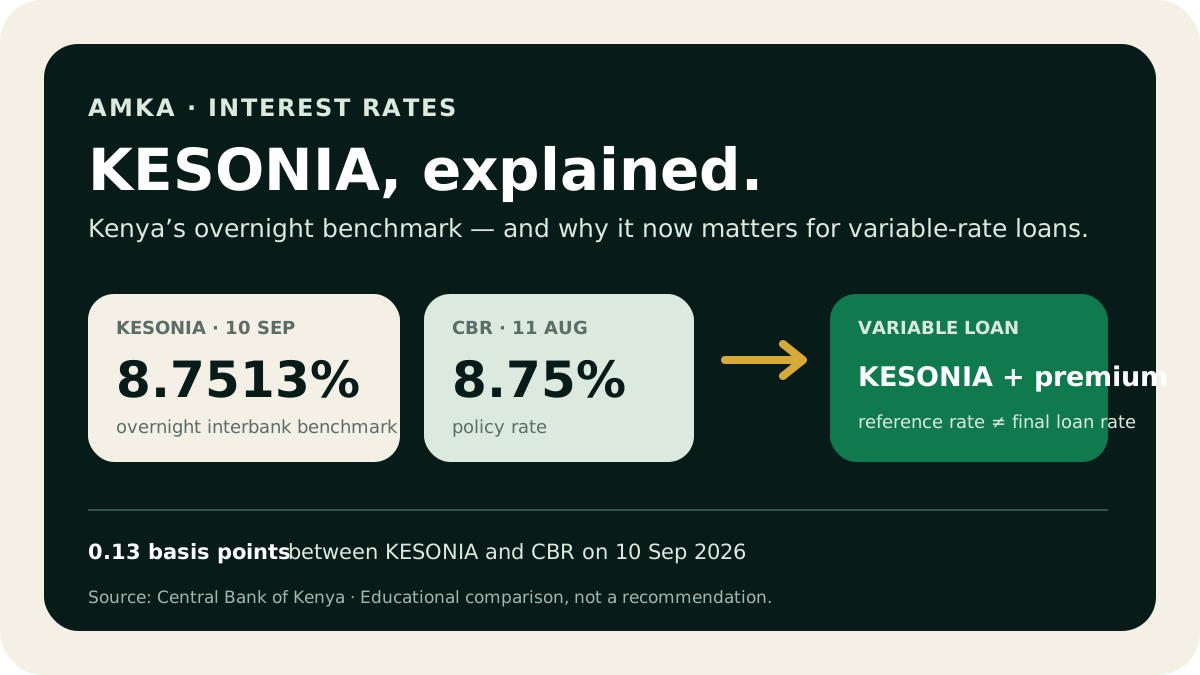
The Central Bank of Kenya (CBK) published KESONIA at 8.7513% for 10 September 2026. The current CBR is 8.75%. That near-perfect alignment is useful context: KESONIA is the market-based overnight benchmark, while the CBR is the policy signal CBK sets.
What is KESONIA?
CBK defines KESONIA as a transaction-based benchmark reflecting the average rate at which Kenyan banks lend and borrow unsecured Kenya shillings overnight. CBK calculates it as a volume-weighted average of actual interbank transactions and publishes it every business day. On weekends and bank holidays, the last working-day rate is held constant.
CBK began publishing the benchmark under the KESONIA name on 1 September 2025. It is intended to serve as Kenya’s near risk-free reference rate and to improve transparency and monetary-policy transmission.
KESONIA vs CBR: what is the difference?
The CBK KESONIA benchmark page describes a rate derived from actual overnight interbank trading. The CBR, by contrast, is set by the Monetary Policy Committee to communicate the monetary-policy stance.
On 10 September, the gap between 8.7513% KESONIA and the 8.75% CBR was only 0.0013 percentage points, or about 0.13 basis points.
Why KESONIA now matters for variable-rate loans
This is the part that makes KESONIA more than a market-data curiosity. Under CBK’s revised Risk-Based Credit Pricing Model, KESONIA is the common reference rate for Kenya-shilling variable-rate loans, except where the framework provides otherwise. New variable-rate loans moved to the revised model from 1 September 2025, while the transition for existing variable-rate loans took effect by 28 February 2026.
The reference rate is only one component of a customer’s final rate. Banks add a customer-specific premium reflecting credit risk and other permitted pricing factors.
That is why an 8.7513% KESONIA does not mean a personal or business loan should cost 8.7513%. CBK’s latest published commercial-bank averages show a 14.39% lending rate and 6.93% deposit rate for July 2026. These measure different markets and products.
How is KESONIA different from a Treasury Bill rate?
A Treasury Bill rate is a government-security auction outcome. KESONIA is an overnight interbank benchmark. The borrower, maturity and market structure are different, so the percentages should not be treated as interchangeable investment returns.
| Rate | What it represents | Typical period |
|---|---|---|
| KESONIA | Unsecured lending between banks | Overnight |
| CBR | CBK monetary-policy signal | Policy setting |
| 91-day T-Bill | Government borrowing through a T-Bill auction | 91 days |
CBK’s Treasury Bills page currently shows previous average rates of 8.7674% for 91 days, 8.9296% for 182 days and 9.0665% for 364 days ahead of the next auction on 17 September 2026.
What should savers and borrowers actually watch?
For borrowers with a variable-rate shilling loan, the useful starting point is the loan agreement: identify the reference rate, the premium or margin, how often the rate resets and which fees sit outside the interest rate. Amka’s Kenya bank loan rates comparison provides product-level context, but lender pricing can differ by customer and facility.
For savers, KESONIA is mainly market context. A deposit, MMF or Treasury Bill should still be compared on its own rate basis, liquidity, fees, tax treatment, risk and evidence date. See Amka’s bank fixed-deposit comparison, Kenya MMF rates and Treasury Bill comparison.
What to watch next
A single daily reading matters less than the trend. The useful signals are whether KESONIA stays close to the CBR, how it moves after future Monetary Policy Committee decisions, and how retail lending rates adjust over time. The next Treasury Bill auction on 17 September also gives another current reference point for short-term government yields.
For more context, read Amka’s latest Kenya Treasury Bill rates explainer and Kenya inflation and interest-rates comparison.
Sources
- Central Bank of Kenya — KESONIA Interest Rate Benchmark, accessed 12 Sep 2026 ↗
- Central Bank of Kenya — Revised Risk-Based Credit Pricing Model ↗
- Central Bank of Kenya — Treasury Bills, accessed 12 Sep 2026 ↗
- Central Bank of Kenya — Commercial Banks Weighted Average Rates ↗