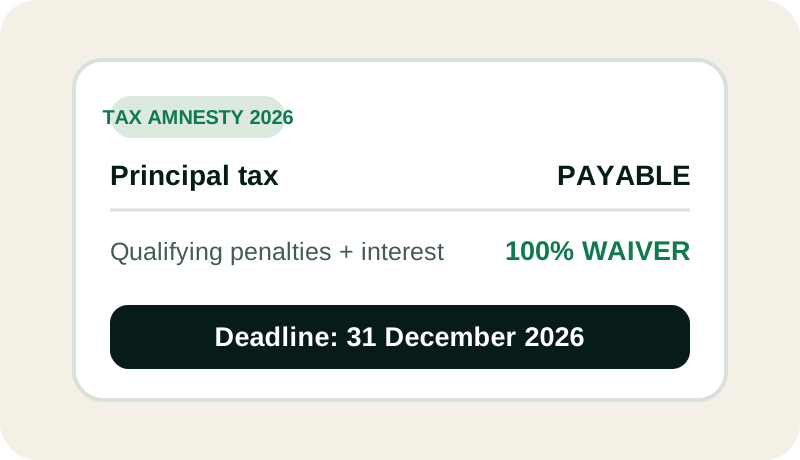
Kenya Revenue Authority’s 2026 Tax Amnesty Programme is open from 1 July to 31 December 2026. The key benefit is a 100% waiver of qualifying penalties, interest and fines linked to tax periods up to 31 December 2025. But the principal tax itself is not waived.
That distinction matters. If a taxpayer still owes principal tax from a qualifying period, the principal must be fully paid by 31 December 2026 for the related penalties, interest and fines to be remitted. KRA’s public notice dated 7 September 2026 also confirms that taxpayers who cannot clear qualifying principal tax in one payment may use an automatic payment plan through iTax, provided the qualifying principal is fully settled before the deadline.
What the 2026 KRA tax amnesty covers
The programme applies to penalties, interest and fines imposed under tax laws administered through the Tax Procedures Act for tax periods up to 31 December 2025. KRA says the amnesty is granted separately by tax obligation and tax period.
The simplest way to think about it is to separate the debt into two buckets: principal tax and the charges added around it. The amnesty can remove qualifying penalties, interest and fines. It does not cancel the principal tax.
Who can qualify?
| Situation | What KRA says |
|---|---|
| No outstanding principal tax, but qualifying penalties, interest or fines remain | Automatic amnesty; no separate application required. |
| Unfiled returns for periods up to 31 Dec 2025 | File the returns. If no principal tax is due, late-filing penalties can qualify automatically. If principal becomes due, it must be fully paid by the deadline. |
| Outstanding principal tax from qualifying periods | Pay in full or use an iTax payment plan, with qualifying principal fully cleared by 31 Dec 2026. |
A simple worked example
Assume an old qualifying tax period shows KES 80,000 principal tax, KES 20,000 penalties and KES 12,000 interest. The total ledger amount is KES 112,000.
This is only an illustration. Actual iTax ledgers can contain different tax periods, obligations, credits or disputed assessments, so eligibility must be checked against the taxpayer’s account and KRA’s rules.
What is not covered
The programme is not a blanket cancellation of every tax balance. KRA’s guidelines specifically exclude principal tax, penalties and interest relating to tax periods from 1 January 2026 onward, customs duties administered under the East African Community Customs Management Act, and agency revenues.
A taxpayer can therefore have qualifying and non-qualifying balances at the same time. The amnesty does not stop current tax obligations from continuing.
How the iTax payment plan fits in
For qualifying principal tax that cannot be paid in one instalment, KRA allows an Automatic Payment Plan through iTax. The taxpayer applies through the Payments menu, creates the plan, generates payment registration numbers and pays the approved instalments.
The key issue is timing. KRA says the qualifying principal must still be fully paid by 31 December 2026. A plan that leaves qualifying principal unpaid after that date will not satisfy the amnesty condition for the unresolved amount.
KRA also advises taxpayers to check payment registration numbers carefully so payments for amnesty periods are directed to principal tax rather than mistakenly paying penalties or interest that may qualify for remission.
What happens after you qualify
Once the relevant conditions are met, KRA says the iTax system processes the amnesty automatically. The taxpayer ledger is updated and an Amnesty Certificate and notification become available through iTax.
For people with no principal tax but outstanding qualifying charges, the relief is intended to be system-driven. For people with principal tax, the trigger is full payment of the qualifying principal within the amnesty period.
Why the 31 December date matters
The programme closes on 31 December 2026. KRA says interest and penalties are not simply frozen while someone waits. If qualifying principal tax is not fully settled by the deadline, the amnesty will not be granted on the unresolved amount.
That makes the useful question less “How much is my total iTax balance?” and more “Which part is principal tax, which periods does it relate to, and which penalties or interest are potentially eligible for amnesty?”
Before paying, reconcile the ledger
Review the iTax ledger by obligation and period. Check for missing returns, old assessments, payments that may not have matched correctly, credits or overpayments, and any objection or dispute that still affects the principal amount.
KRA’s guidelines say validated credits or overpayments may be offset against tax liabilities in line with the law. They also encourage taxpayers with disputes or amendments to resolve them early enough for any agreed principal tax to be paid before the deadline.
Amka’s Kenya tax rates dashboard gives a quick view of common tax rates, while this amnesty concerns historical compliance balances rather than a new tax rate. You can also use the Amka tax calculators for simplified learning calculations. For the underlying amnesty rules, rely on current KRA guidance and the Tax Procedures Act as amended by the Finance Act 2026.
Sources
- Kenya Revenue Authority — Tax Amnesty on Interest, Penalties and Fines, 7 Sep 2026 ↗
- KRA — Guidelines on the Implementation of Tax Amnesty 2026, 1 Sep 2026 ↗
- KRA — 2026 Tax Amnesty Programme at a Glance ↗
- KRA — Finance Act 2026: What It Means for You ↗